This page explains the funding available through the Blackdown Hills National Landscape for 2026–27 and how to identify the most suitable option. Use this guidance if you are:
- A farmer or land manager looking to apply for funding
- An adviser supporting applications
- A partner looking to understand our funding streams
This guidance gives an overview of funding available and detail on eligible applications for the Wildlife Rich Habitat Fund and Capital uplift (30 by 30) funds. This includes maps highlighting areas with ‘potential’ for enhancement to achieve ‘actual’ 30 by 30 habitat, and target areas for wildlife-rich habitat creation, focused within our existing nature recovery areas.
For further conversations regarding capital funded applications, please contact Hannah Metson Hannah.metson@devon.gov.uk
To explore our Blackdown Hills National Landscape Viewer, click here.
Comparing Wildlife-rich Habitat Fund, Capital uplift (30by30) funds, and FiPL
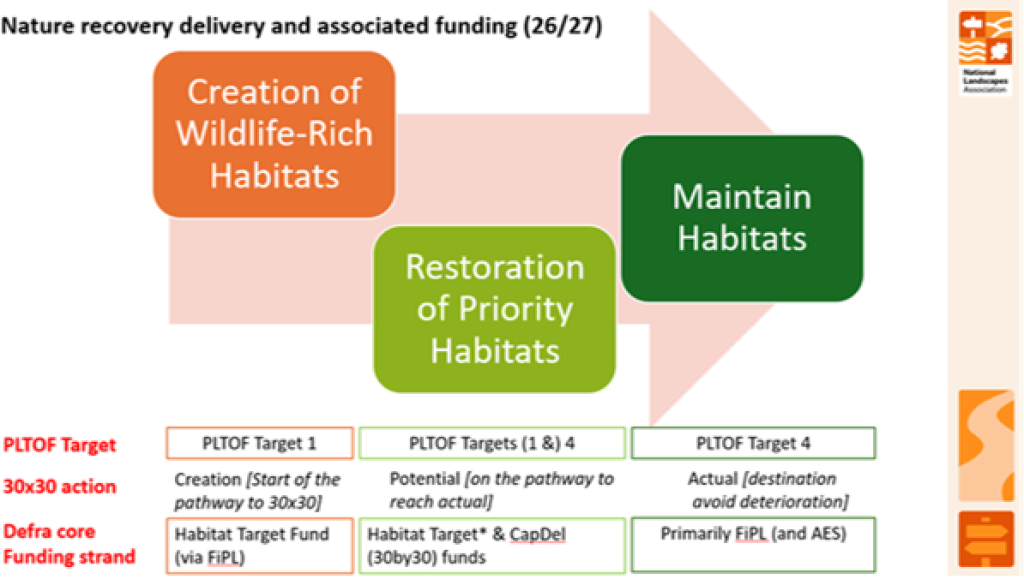
Defra has provided additional funding to help meet nature recovery targets. The diagram below helps to outline how the different funds support initial creation of wildlife-rich habitats (outside of protected sites), restoration of existing priority habitats, and maintenance of habitats.
Capital vs. Revenue Funding
Both Wildlife-rich Habitat Fund and Capital uplift (30 by 30) uplift funding are purely capital, unlike FiPL which can offer both capital and revenue funding.
| Words indicating Capital expenditure | Words indicating Revenue expenditure |
| Enhance | Repair |
| Upgrade | Maintain |
| Extend | Replace |
| Improve | Like-for-like |
| Construct | Remedial |
| Purchase | Renew |
What does capital funding mean in practice?
- Funding must be used for activities that create or significantly improve a physical asset, such as new or restored habitat or supporting infrastructure
- Projects must deliver a lasting environmental benefit (at least one year or more)
- Funded works must be sufficient to fully establish the habitat or feature, not partial or incomplete actions
- Funding can only support costs that are essential to delivering the on-the-ground works
Capital funding cannot be used for:
- Ongoing management or maintenance (e.g. grazing, cutting, repairs)
- Reports, guidance, or promotional activity
- Any ongoing management required after the project must be secured through other funding sources (e.g. SFI, Countryside Stewardship, or private funding)
Guidance for targeting Wildlife Rich Habitat Fund and 30 by 30 Capital uplift funding
Wildlife Rich Habitat Fund
The Wildlife-rich Habitat Fund (WHF) offers entirely capital funding to support actions which will create new wildlife-rich habitat. Funded actions must be sufficient to allow the habitat to develop and align with Natural England definitions.
What it will fund
- Creation on land where wildlife‑rich habitat is currently absent.
- Restoration‑as‑creation of certain degraded habitats (e.g. coastal floodplain grazing marsh when restored to wetland, woodland with less than 70% native canopy, rivers and streams where all pressures are addressed).
Eligible habitat types must be listed in Table 2 of TIN219 (Priority Habitats and Schedule 1 habitats) and be capable of reaching sufficient quality over time.
The Blackdown Hills National Landscape have identified four key areas where wildlife-rich habitat creation would be eligible and most beneficial within our landscape;
- Lost traditional orchards
- Good quality semi-improved grassland
- No main habitats but additional habitats present
- Plantations on Ancient Woodland Sites (PAWS)
What it cannot fund
- Maintenance or enhancement of existing wildlife‑rich habitat.
- Partial or insufficient actions.
- Compensatory habitat required through planning consent.
- Actions on sites designated as protected (e.g. SSSIs, SACs) as of January 2023.
- Habitat creation that damages or replaces an existing wildlife‑rich habitat.
- Land purchase
Capital uplift (30 by 30) funding
Capital uplift funding supports actions which will confidently restore habitat to meet criteria of ‘actual’ 30 by 30. The Blackdown Hills National Landscape have been assigned £157,000 of capital uplift funding for 2026/27. This funding is for capital expenditure which can target ‘potential’ 30by30 areas and new connected habitats.
What it will fund
There are two methods to create 30 by 30 habitat. Our priority is to convert the mapped ‘potential’ 30 by 30 habitat to ‘actual’ habitat, but there is still place to create/ restore habitat where it improves habitat connectivity.
- Convert ‘potential’ 30 by 30 habitat to ‘actual’ 30by30 habitat
- Creation/ restoration of connected habitat
In addition, maintaining condition and avoiding deterioration of priority habitat remains a key priority.
Note for context: the 30 by 30 classification 30by30 on land in England: confirmed criteria and next steps – GOV.UK links to the Protected Landscapes Targets & Outcome Framework (PLTOF) ) Protected Landscapes Targets and Outcomes Framework – GOV.UK, notably targets 1 to 4. This is because habitats created or restored can count towards PLTOF targets, as well as 30 by 30. The Government are still defining this synergy/ overlap and how to accurately record it.
The published 30by30 criteria:
- Purpose: The purposes or management objectives for this area must ensure the delivery of in-situ conservation outcomes.
- Protection: The conservation of this area must be secured for at least 20 years, through legal or other effective means.
- Management: The area’s governance or ownership must have the ability to implement reasonable management actions to achieve in-situ conservation outcomes.
- Management: There must be a management plan or similar that is designed to deliver in-situ conservation outcomes.
- Management: Management measures are being implemented, with appropriate monitoring, evaluation and learning in place to assess progress and inform future management.
- Management: The area is achieving, or making progress towards, in-situ conservation outcomes, with reasonable confidence that these outcomes will be achieved.
Capital uplift funding can be used in association with agri-environment schemes, so long as there is no double funding. Where an item or activity can be funded via standard agri-environment schemes these should be prioritised.
Examples of capital expenditure:
- Enable ‘sustainable’ grazing management- e.g. holding pens for cattle, livestock management (e.g. stock fencing), GPS (no fence) collars.
- Invasive scrub control using machinery- e.g. removal of invasive scrub on spring line mires and creation of butterfly flyways.
- Equipment to manage ‘difficult’ sites e.g. bracken basher.
- Bringing undermanaged woodlands back into management e.g. glade and ride restoration, machinery access, coppicing and thinning.
- Connecting features (such as ‘new’ hedges and copses) and ‘stepping stones’ (areas restored through capital works to provide feeding opportunities for priority species).
1. Convert ‘potential’ 30by30 habitat to actual 30by30 habitat
The current ‘potential’ of the Blackdown Hills National Landscape to achieve 30 by 30 is 20% of the total area (i.e. restore all extant priority habitat). Of this, the current ‘actual’ (meeting 30 by 30) is 10% of the total Blackdown Hills National Landscape area (3,700ha), with the majority in Somerset.
Therefore, to reach 30 by 30, 10% more priority habitat would need to be re-created in the Blackdown Hills National Landscape
The mapped ‘potential’ 30 by 30 areas include regions which already have some protections or management in place, and habitats with important biodiversity value. The criteria used to identify these areas help determine which regions and habitats have the potential to contribute towards the 30 by 30 goal without significant land use changes, given support from landowners, land managers, targeted action, and investment. The term ‘potential 30 by 30 areas’ refers to broad areas and does not imply that these entire areas will be able to contribute to 30 by 30 in the future.
Areas mapped as ‘Potential 30by30 Areas’:
| Protected areas | Special Sites of Scientific Interest (SSSIs in unfavourable condition), Special Protection Areas (SPA), Special Area of Conservation (SAC), Ramsar sites, Local Nature Reserves, National Nature Reserves |
| Deciduous woodland | National Forest Inventory filtered to deciduous woodland categories. |
| Ancient woodland | Ancient Woodland data excluding conifers. |
| Woodland pasture and parkland | Wood pasture and Parkland data excluding conifers. |
| Priority habitat | Priority Habitat Inventory excluding deciduous woodland or peat |
| Surface water | Surface water from OS OpenMap Local |
N.B. Deep peat counts as potential 30by30 but there is none mapped within BHNL.
2. Creation/ restoration of connected habitat
In addition to improving condition of habitat to take sites from ‘potential’ 30 by 30 area to ‘actual’ 30 by 30 area, priority habitat can be created/ restored to become ‘actual’ area for 30 by 30. This must be in areas where creation/ restoration improves connectivity between existing priority habitats classed as ‘potential’ 30 by 30 areas within the ‘potential’ 30 by 30 maps.
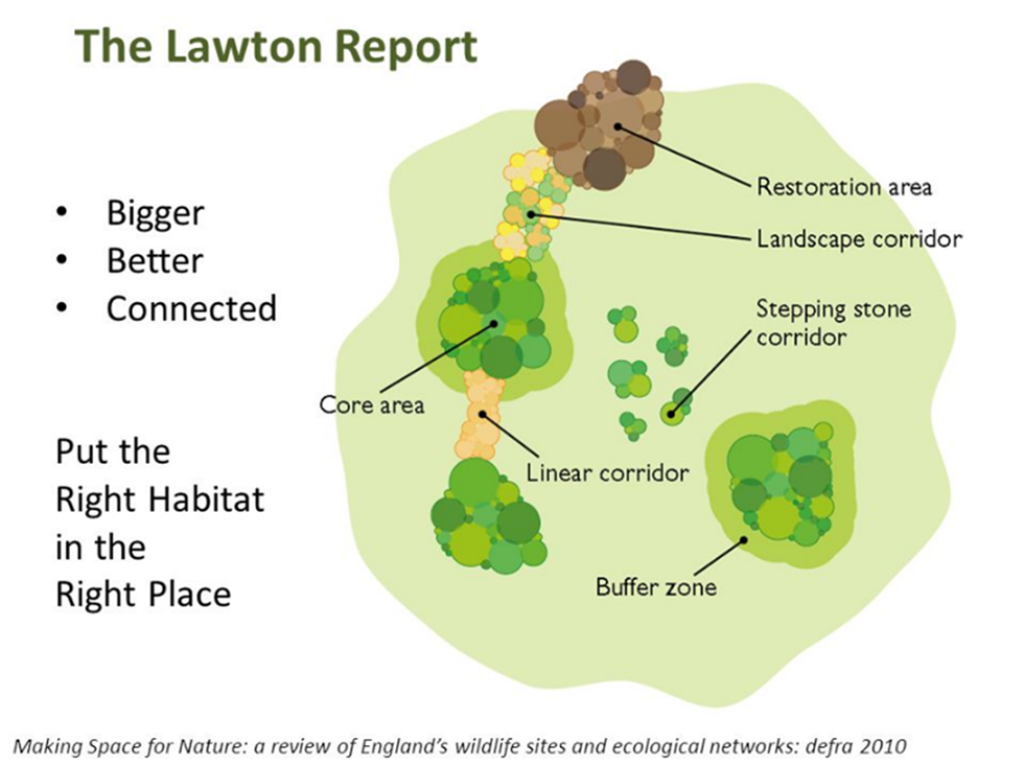
The schematic below, taken from the The Lawton Report (DEFRA, 2010) illustrates the importance of creating/ restoring connected ecological networks. This is valuable to allow species and genes to move between habitats.
What funding can pay for
Example 1: Creation of wildlife-rich habitat and actual 30 by 30
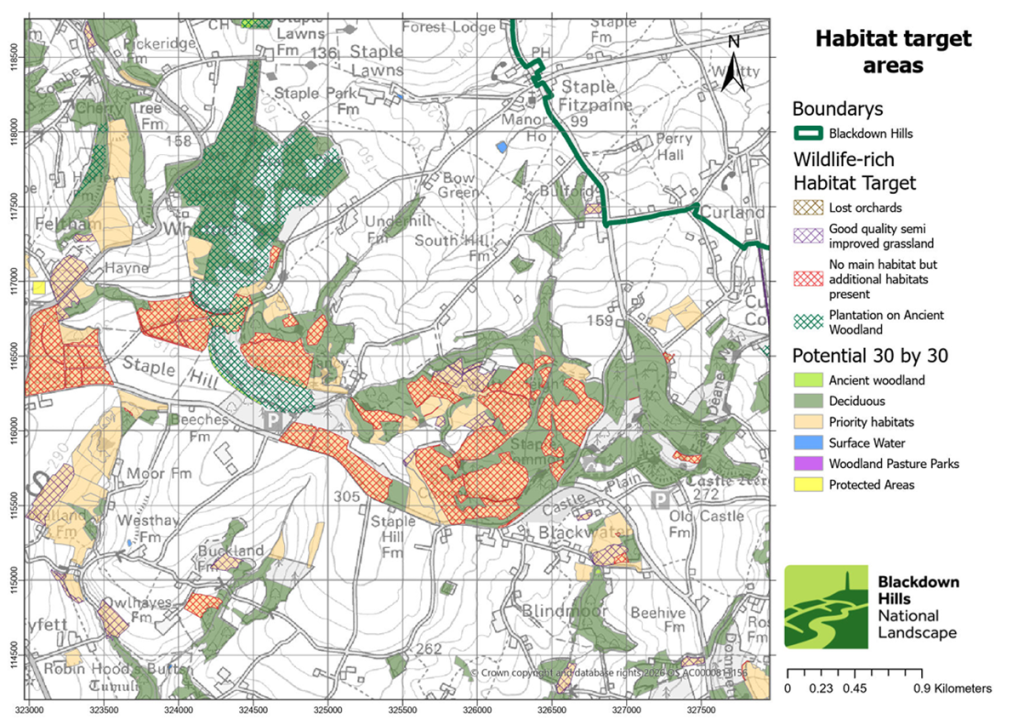
This map highlights areas of high potential for targeting wildlife-rich habitat creation and capital uplift (30 by 30) funding in Staple Fitzpaine. The area shows a strong concentration of opportunities, making it a priority for habitat enhancement and connectivity. In this location, wildlife-rich habitat and 30 by 30 funding could be used together to deliver more joined-up and resilient habitat networks.
Carbon sequestration potential in the BHNL
This research developed a spatial tool to identify where habitat creation and restoration would deliver the greatest soil carbon sequestration benefits across the BHNL. It combined soil, habitat, land management and designation datasets and assessed carbon outcomes under three intervention scenarios (maximum, moderate and minimal). Particular focus was placed on high‑potential soil types (Hense and Whimple soils), enabling the identification of priority areas where interventions are both impactful and most achievable.
The results show that restoring Hense soils to wetland mosaic habitat offers the highest carbon sequestration potential, while Whimple soils present a large‑scale opportunity for carbon gains through woodland creation or conversion to wildlife‑rich grassland. Moderate, targeted intervention provides a realistic and high‑impact pathway, whereas minimal management change delivers only marginal gains. These findings directly support the targeting of funding by identifying priority locations where investment in habitat creation, restoration and management will deliver the greatest combined carbon and biodiversity outcomes, aligning with Nature Recovery, FiPL and Net Zero objectives.
You can read the full report here:
Maps for fund targeting
The BHNL has produced an interactive viewer where you can view all of these fund targeting layers – Blackdown Hills National Landscape Viewer
The following composite map highlights land (dark green) where advise and funding should be targeted to meet maximum habitat and soil carbon sequestration outcomes. The darkest areas illustrate the overlap between either habitat improvement potential; wildlife rich habitat creation or 30 by 30 creation, and hence soils, which have the greatest potential to sequester carbon. These areas should be the priority focus for funding and farm advisory work.